
Many car drivers are surprised that their batteries "die" earlier than expected, even though their cars don't have an automatic start-stop system. Yes, if you drive a car equipped with that sophisticated system, it will indeed put extra strain on the battery, as discussed in a previous article. However, a bigger factor is that your driving pattern also contributes to your car battery's lifespan.
Take Kuala Lumpur, for example. The combination of traffic congestion, short trips, and high ambient temperatures creates conditions that are tough on a car battery.
City driving strains your car battery
The frequency of stopping and starting when driving in the city is much higher than driving on rural roads or highways. Even without start-stop technology, the engine is turned on and off more often, for instance, when you arrive at your favourite café, the bank to deposit a cheque, the office to drop off documents, and so on.
Every time the engine starts, the battery discharges a large amount of power in an instant. Once the engine is running, the alternator needs to replenish that energy while simultaneously powering other electrical components like the air conditioning, lights, dashboard, and infotainment system.
An undercharged battery triggers sulfation problems
The problem arises when the charging system doesn't have enough time to fully replace what was used to start the engine. Over time, this leads to a situation where the battery is constantly left in a partially charged state.
If this continues, it will gradually cause permanent damage to the battery. A phenomenon called sulfation forms around the battery plates and permanently impairs the battery's ability to store energy. As a result, battery capacity decreases significantly, CCA (Cold Cranking Amps) drops, and once CCA falls below what the engine needs to start, the car will fail to start.
That explains why car batteries tend to have an unusually short lifespan when driving in the city.
On top of that, Malaysia's climate is already hot and humid. Combined with the confined engine bay, which can reach temperatures of between 40°C and 45°C, this places even greater strain on the car battery.
How to extend your car battery's lifespan
If you have no choice but to drive in the city, avoiding traffic congestion is nearly impossible. What you can do, however, is occasionally take a longer drive out of town to allow the battery to fully recharge. To prevent any energy drain, make sure all electronic and electrical equipment is switched off before turning off the engine.
Most importantly, make sure your car battery's specifications meet or exceed those recommended by the car manufacturer. For example, more advanced batteries such as EFB and AGM last longer than non-Maintenance Free (MF) batteries. Finally, check your battery's condition regularly to catch any issues early before they become more serious.
Look for Astra Battery for your next replacement
Short trips, traffic congestion, and hot environments are among the factors that affect your car battery's lifespan. Understanding these factors allows you to adjust the way you use your car so that this component stays in good condition.
Every car battery will eventually reach the end of its life. So, for your next replacement, look for Astra. Astra is Bateriku's in-house brand, offering a wide range of MF, EFB, and AGM automotive batteries for all types of vehicles in Malaysia.
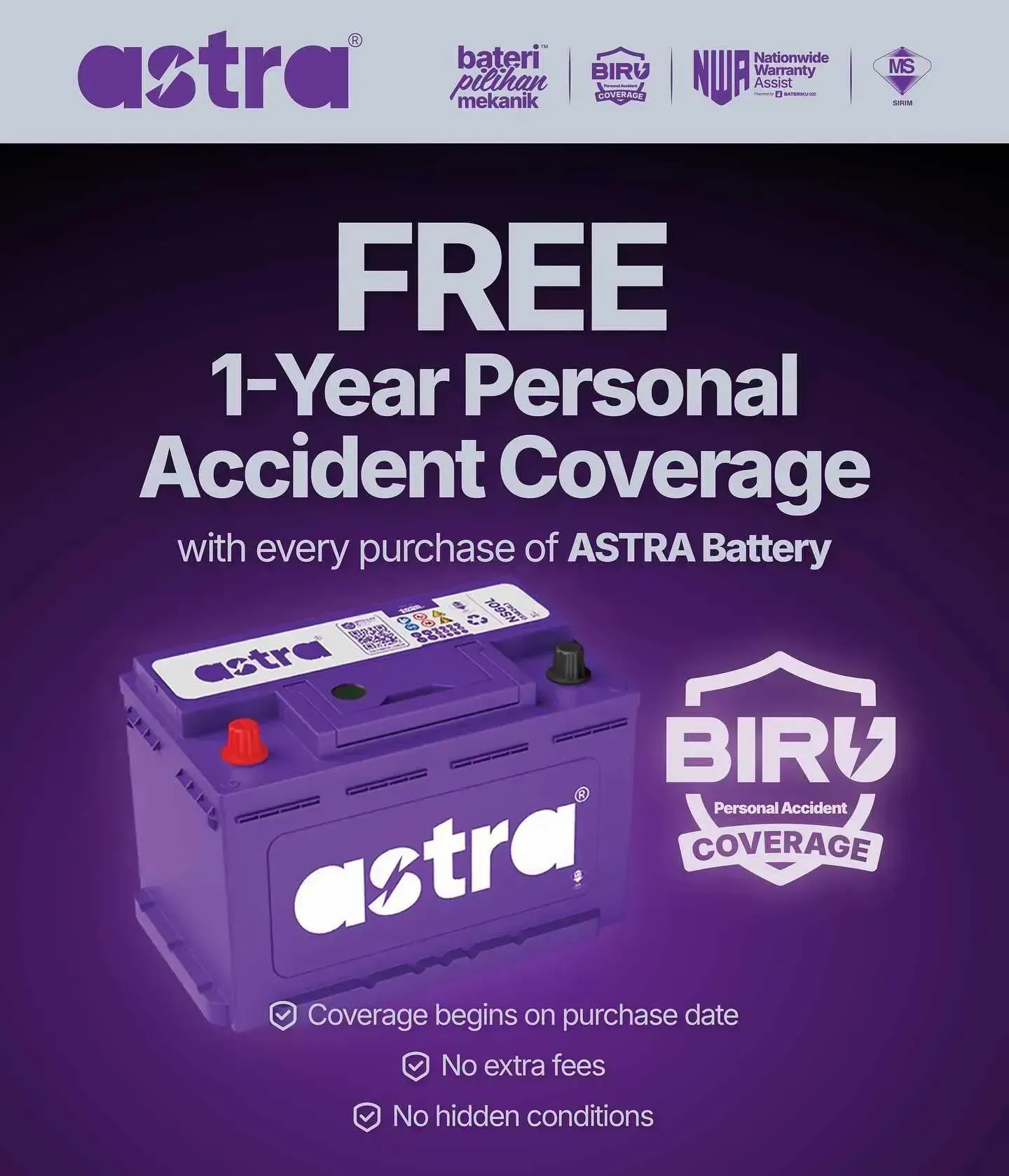
Astra products are backed by a nationwide warranty supported by Bateriku's automotive service network. Every Astra battery purchase also comes with Group Personal Accident (GPA) Takaful Protection worth up to RM7,000 from Zurich Takaful Malaysia for 12 months.
You can browse the Astra battery catalogue to find the model that suits your car.